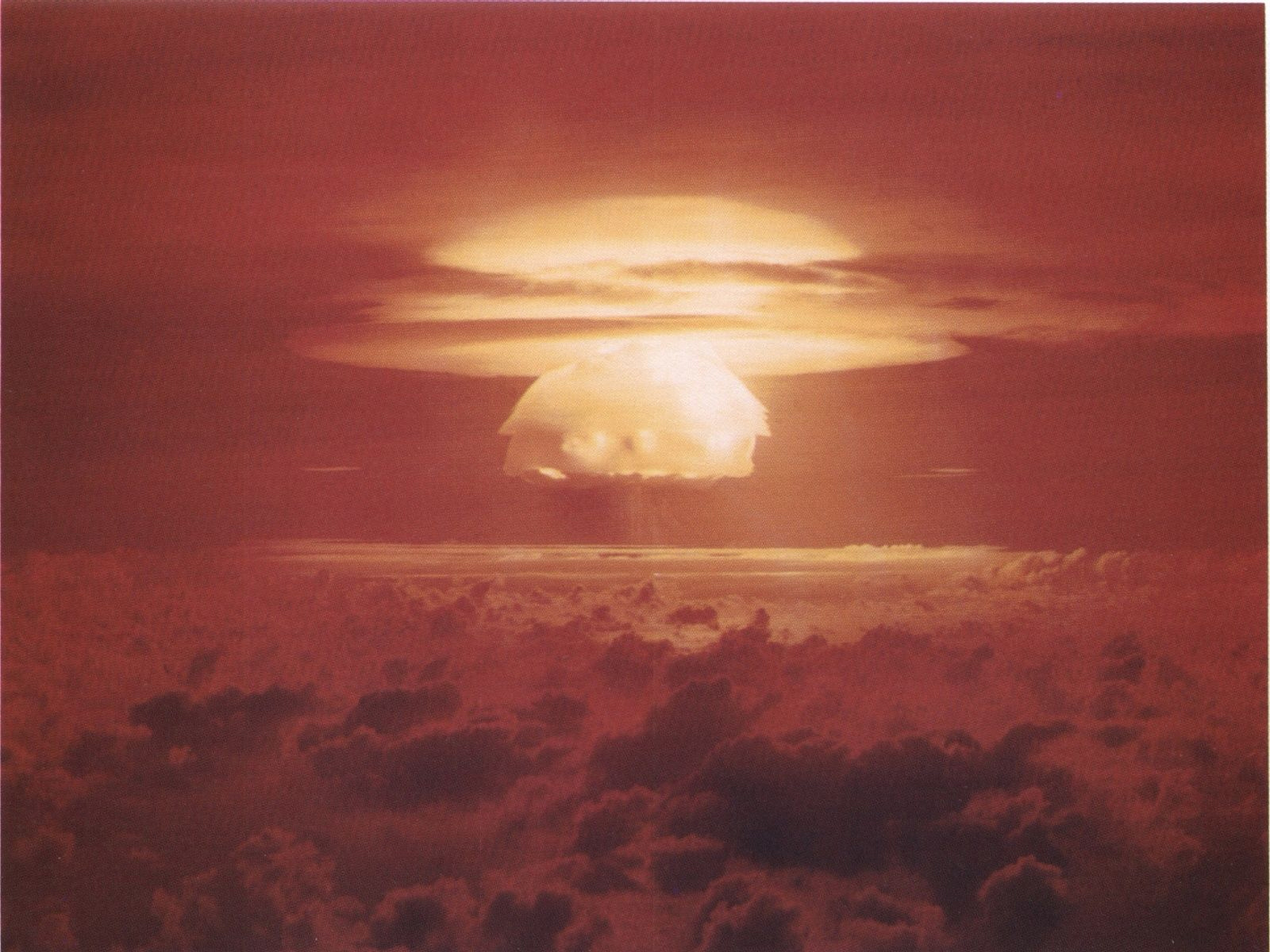
Bravo was a 15 Mt two stage
thermonuclear surface burst. This was the first "dry" or solid fuel
H-Bomb tested by the U.S., and the first solid fuel Teller-Ulam device
ever tested. It was the largest bomb ever tested by the U.S. although
this was by accident. The yield of Bravo dramatically exceeded
predictions, being about 2.5 times higher than the best guess. The
reason for the unexpectedly high yield was due to the "tritium bonus"
provided by the lithium-7 isotope which made up most of the lithium.
The Bravo crater in the atoll reef had
a diameter of 6510 ft, with a depth of 250 ft. Within one minute the
mushroom cloud had reached 50,000 feet. The cloud top rose and peaked at
130,000 feet after only six minutes. Eight minutes after the test the
cloud had reached its full dimensions with a diameter of 100 km, a stem
7 km thick, and a cloud bottom rising above 55,000 feet.
The Bravo test created the worst
radiological disaster in US history. Due to failure to postpone the test
following unfavorable changes in the weather, combined with the
unexpectedly high yield and the failure to conduct pre-test evacuations
as a precaution, the Marshallese Islanders on Rongerik, Rongelap,
Ailinginae, and Utirik atolls were blanketed with the fallout plume.
They were evacuated on March 3 but 64 Marshallese received doses of 175
R. In addition, the Japanese fishing vessel Daigo Fukuryu Maru was also
heavily contaminated, with the 23 crewmen receiving exposures of 300 R
(one later died - apparently from complications). The entire Bikini
Atoll was contaminated to varying degrees, and many operation Castle
personnel were subsequently over-exposed as a result.